The language techniques are the methods that speakers and writers use to make interaction more persuasive and memorable. If you are writing an essay or preparing for a specific exam or analysing a poem, knowing these techniques can assist you interpret texts more clearly and enhances your own writing.
Thus, each technique serves a varied purpose in interpreting meaning and influencing readers. In this write-up, you will learn what language techniques are and their different types with clear examples and discover practical tips for identifying them in any text, making literary analysis much easier.
Types of Language Techniques
Language techniques also termed as rhetorical devices are different methods that writers use to make their writing more interesting, engaging, and effective. Each technique has a particular purpose like creating vivid images, adding emotion, or making an argument more convincing.
Figurative Language Techniques
Figurative language uses words in a non-literal way and creative style to help readers imagine opinions and connect emotionally with the text.
Examples:
Metaphor
Symbolism
Hyperbole
Sound & Phonetic Techniques
Sound techniques use repeated sounds to enhance the flow, rhythm, and mood of writing, which makes it more memorable and enjoyable to read.
Examples:
Alliteration
Consonance
Assonance
Structural and Sentence-Level Techniques
These techniques stress how sentences and ideas are organised. Writers use structural techniques to control the pace and highlight important points and build suspense.
Examples:
Flashbacks
Repetition
Short sentences
Antithesis
Persuasive and Rhetorical Techniques
Persuasive techniques are very common in speeches, debates, and persuasive writing. This is majorly used to influence the audience.
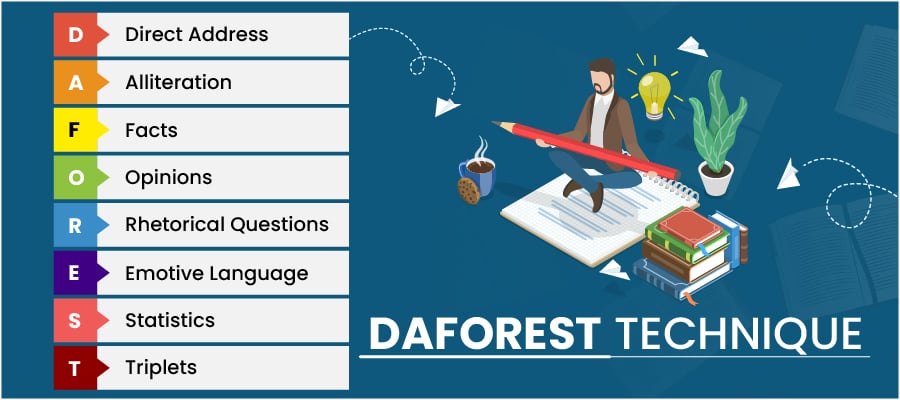
Most of these techniques are grouped under the DAFOREST framework.
50 Language Techniques: Definitions & Examples
The language techniques given below are among the most common ones that appear in literary works, speeches, advertisements, poetry, and even in regular conversation.
Simile
If we want to compare two entirely different things, we often use words such as like or as. But Simile solves this problem, and writers use similes to make descriptions more up to the point and assist readers understand unfamiliar ideas by relating them to something they already know.
Example:
His smile was as bright as the morning sun.
Effect:
Creates various comparisons and helps readers easily imagine the details.
Metaphor
To compare two diverse things by saying one thing is other without using words like or as, usually Metaphor is used.
It shows deeper meaning, makes writing more creative, and encourages readers to think beyond the literal sense. Metaphor states one thing is another to create a stronger and more imaginative or creative comparison.
Example:
Her mind is a strong engine that never stops working.
Effect:
Includes creativity, depth, and stronger emotional impact.
Personification
For giving human qualities like emotions or actions to animals and objects, Personification works best.
It helps to create information more lively and allows readers to connect emotionally with non-human things.
Example:
The flowers danced happily in the gentle breeze.
Effect:
Gives writing a more engaging and emotional touch.
Alliteration
To create rhythm, improve the flow of sentences, and make phrases more memorable, Alliteration is used.
Alliteration is the repetition of the same consonant sound at the beginning of nearby words.
Example:
Green butterflies bounced between blooming bushes.
Effect:
Creates rhythm and makes important phrases easier to remember.
Hyperbole
For an intentional exaggeration which is used to emphasise an idea or feeling, Hyperbole is used.
It is however not meant to be taken in a literal sense but makes descriptions more dramatic and entertaining or emotionally powerful at the same time.
Example:
This backpack weighs a hundred kilograms!
Effect:
Adds drama and humour to the content.
Imagery
Descriptive language is used in the imagery style to appeal to the five senses including sight, sound, smell, taste, and touch.
It helps readers create accurate clear mental pictures and experience the sense as if they were there.
Example:
The perfect smell of freshly baked cake filled the entire kitchen.
Effect:
Builds minute detailed mental images and makes writing more immersive.
Repetition
Repetition is the inventive use of the same kind of word, phrase, or idea more than once to highlight its importance.
It strengthens the writer's message and helps readers remember key points.
Example:
We believe in respect and we believe in change.
Effect:
It stresses important ideas and improves memorability.
Rhetorical Question
A rhetorical question is asked to encourage readers to think rather than to receive an actual answer.
It is commonly used in speeches and persuasive writing to engage the audience and support a statement or argument.
Example:
How much longer can we afford to ignore climate change?
Effect:
Motivates readers to reflect and become more engaged.
Onomatopoeia
Onomatopoeia uses word which imitate natural sounds and that makes writing more realistic and engaging.
These sound words help readers to imagine the action more clearly and bring scenes to life.
Example:
The fireworks went crack, and pop across the sky.
Effect:
Develops realistic sound effects and vivid descriptions.
Irony
Irony builds when actual outcomes are different from what is expected or when words mean the opposite of their actual (literal) meaning. In this, writer uses irony to create surprise, humour, or a deeper message.
Example:
A traffic officer gets a speeding ticket.
Effect:
Gives surprise, humour, or highlights a vital point.
Oxymoron
An oxymoron blends two words with distinct meanings to build a unique expression. This technique reflects the contrasts, makes readers think in-depth, and adds interest to the writing.
Example:
The classroom was filled with organised chaos.
Effect:
Emphasises contrasting ideas and creates a memorable expression.
Symbolism
If any action or object represents a deeper meaning way beyond its literal meaning, Symbolism techniques can be best used.
If writers want to communicate typical ideas, themes, and emotions without directly explaining them, symbolism allows readers to interpret the text on a deeper level.
Example:
The white bird symbolised peace and hope after the storm.
Effect:
It adds deeper meaning and encourages readers to interpret hidden messages.
Assonance
Assonance is the kind of repetition of the same vowel sounds in nearby words. It creates rhythm that enhances the musical quality of writing and assists in emphasising vital ideas or emotions.
Example:
The rain in Europe stays mainly in the plain area.
Effect:
Builds smooth rhythm and makes sentences more memorable.
Consonance
Consonance is the repetition of consonant sounds within or at the end of the closest words. Writers use consonance to enhance flow, add stress, and create pleasing sound patterns.
Example:
The strong string stretched all across the bridge.
Effect:
Improves rhythm and reinforces key phrases.
Emotive Language
Emotive language uses carefully chosen words to evoke strong feelings including anger, sadness, or fear. This is widely used in persuasive writing, speeches, and advertisements to influence the emotions of the audience.
Example:
Innocent families are looking for your support today.
Effect:
Builds an emotional connection and strengthens persuasion.
Juxtaposition
Juxtaposition places two different ideas, characters, or images close together to reflect their main differences. This comparison helps readers better understand both elements.
Example:
The luxurious palace stood beside a row of old houses.
Effect:
Reflects the contrast and emphasises vital themes.
Foreshadowing
Foreshadowing provides subtle hints about events which will happen later in the story. It creates curiosity and prepares readers for further developments without revealing everything.
Example:
Dark clouds gathered just before the journey began.
Effect:
Builds suspense and keeps readers engaged.
Anecdote
An anecdote is mainly a short personal story which is used to explain a particular idea, entertain readers, or assist an argument. Writers often use anecdotes to make their writing more memorable.
Example:
When I forgot my umbrella, then I came to know how unpredictable the weather can be.
Effect:
Makes writing more personal and engaging.
Euphemism
A euphemism replaces a harsh or unpleasant expression with a softer or more polite one. Euphemism is often used in formal communication and sensitive discussions.
Example:
He passed away peacefully last night.
Effect:
Softens tough topics and maintains a respectful tone.
Satire
Satire uses irony, humour, or exaggeration to criticise people, society, or political issues. Writers often use satire to encourage readers to reflect on real-world problems.
Example:
The cartoon mocked politicians who made endless promises but achieved little.
Effect:
Entertains while exposing flaws or motivates for social change.
Pun
A pun is a kind of play on words which takes advantage of multiple meanings or similar sounds. This is commonly used for humour and clever wordplay.
Example:
I used to be a cook because I have already chopped the veggies.
Effect:
Builds humour and makes writing more memorable.
Idiom
An idiom is a kind of phrase whose meaning cannot be understood from the single words alone. Idioms make language more natural and expressive.
Example:
She finally broke the ice during the meeting.
Effect:
Makes a person's communication more conversational.
Allusion
An allusion is an indirect reference to a famous person, event, place, or literary work. Writers use allusions to add meaning without lengthy explanations.
Example:
He was a real Einstein while solving the puzzle.
Effect:
Creates depth and connects ideas to familiar references.
Tone
Tone refers to the speaker's attitude towards the subject or audience. It can be formal, humorous, serious, optimistic, sarcastic, or emotional on the basis of purpose.
Example:
The coach spoke with an encouraging tone before the match.
Effect:
It shapes how readers interpret the message.
Mood
Mood is the kind of emotional atmosphere which a piece of writing develops for readers. Writers build mood via descriptive language, setting, and imagery.
Example:
The silent forest under the moonlight created an eerie mood.
Effect:
Reinforces the core ideas and includes persuasive impact.
Need Help With Writing Good Quality Content
Tired of Writing Quality Content? Let our experts take over.
Anaphora is the repetition of the same kind of word or phrase at the beginning of successive sentences or clauses. It includes emphasis and creates a powerful rhythm.
Example:
We will learn and improve and will succeed.
Effect:
Reinforces the key ideas and adds persuasive impact.
Contrast
Contrast stresses differences between ideas, characters, or conditions. It allows crucial qualities to stand out more clearly.
Example:
One brother was strong and fearless whereas the other avoided every risk.
Effect:
Stresses differences and strengthens meaning.
Paradox
A paradox is a statement which seems contradictory but reveals a strong or deeper truth when considered carefully.
Example:
Less is more.
Effect:
Pushes readers to think critically.
Climax
Climax arranges ideas or events in increasing order of importance or intensity until reaching the top point.
Example:
She smoked, shouted, and finally screamed.
Effect:
Builds excitement and dramatic impact.
Flashback
A flashback technique interrupts the present narrative to describe an earlier event. It offers background details which help readers know the actual situations.
Example:
As soon as she opened the old letter, childhood memories returned.
Effect:
Builds characters and adds context.
Short Sentences
Short sentences use only a select few words to create emphasis or increase tension. They often appear during crucial moments in a text.
Example:
Nothing happened even he waited.
Effect:
Builds suspense and draws attention.
Statistics
To support an argument and increase credibility, statistics use numerical facts or data. Statistics are commonly found in persuasive and detailed writing.
Example:
Over 90% of students preferred online mock tests.
Effect:
Strengthens arguments with evidence.
Inclusive Language
Inclusive language uses words including we, our, and us to make readers feel involved and valued.
Example:
We can create a better future together.
Effect:
Builds unity and encourages participation.
The Rule of Three
The rule of three groups ideas into sets of three as they sound balanced, memorable, and persuasive.
Example:
Just stop, think, and act accordingly.
Effect:
Makes messages more effective and memorable.
Sibilance
Sibilance is the repetition of soft accents like “s” or “sh” sounds to create atmosphere or emphasis.
Example:
The silent snake slithered slowly.
Effect:
Produces a smooth or eerie sound effect.
Colloquialism
Colloquialism uses everyday informal language commonly spoken in a particular region or culture.
Example:
I will catch you later.
Effect:
Makes dialogue sound natural and realistic.
Cliché
A cliché is an overused expression which has lost much of its originality as it has been repeated so often.
Example:
Better late than never.
Effect:
Conveys familiar ideas quickly, though it may reduce originality.
Understatement
Understatement deliberately reflects something as less crucial or serious than it really is.
Example:
After winning the trophy, he said that it went very well.
Effect:
Engages readers personally.
Direct Address
Direct address speaks directly to the audience by using words like “you” or “your”.
Example:
You have the power to make a difference.
Effect:
Engages readers personally.
Diction
Diction refers to the choice of words by the writer, and different word choices can create various meanings, tones, and emotions.
Example:
The army marched instead of walked.
Effect:
Diction shapes tone and strengthens expression.
Parallelism
This technique repeats similar grammatical structures to improve clarity and rhythm.
Example:
She likes travelling, writing, and reading.
Effect:
It creates flow and reinforces the idea.
Ellipsis
Ellipsis intentionally leaves out particular words or uses three dots to highlight a pause or unfinished thoughts.
Example:
If only I had known...
Effect:
Creates suspense or emotional tension.
Caesura
Caesura is an intentional pause within a line of poetry, mainly marked by punctuation.
Example:
The sun had set and then darkness starts.
Effect:
It controls rhythm and includes dramatic emphasis.
Enjambment
Enjambment technique applies when a sentence continues onto the next line of poetry without a punctuation mark.
Example:
The river flowed very quietly into the valley where dreams rested.
Effect:
Develops a smooth flow and maintains momentum.
Pathos
Pathos language technique directly appeals to the emotions of the audience to inspire sympathy, compassion, or concern.
Example:
Every child deserves a safe place to call home.
Effect:
Gives emotional impact and motivates action.
Logos
Logos technique deals with the appeal to logical factors through facts, evidence, and clear reasoning.
Example:
Research reflects that regular exercise improves heart health.
Effect:
Gives authenticity to your argument through valid data.
Ethos
To show expertise, trustworthiness, or authority, Ethos language technique is used.
Example:
As a doctor with 15 years of experience, I suggest regular health checkups.
Effect:
Develops trust and robust persuasion.
Antithesis
Antithesis places opposite ideas in parallel structures to highlight contrast and create emphasis.
Example:
Speak less and achieve more.
Effect:
Gives a contrasting effect and is more striking and memorable.
Innuendo
Innuendo suggests a hidden meaning or indirect criticism without stating it openly.
Example:
She certainly has an interesting way of arriving on time.
Effect:
Implies meaning subtly and creates intrigue.
Pathetic Fallacy
Pathetic fallacy gives human emotions to weather or the natural environment to reflect a character's feelings.
Example:
The angry storm raged as he walked in disappointment.
Effect:
Enhances the mood and mirrors emotions via nature.
Language Techniques for Exams (GCSE, A-Level, HSC)
For language techniques GCSE and A-Level exams, recognising a technique is not enough; getting marks depends on your ability to explain the effects it creates. Here is exactly what the examiners want.
Learn the most tested techniques - The most frequently tested ones across language features GCSE and A-Level papers are:
Metaphor and simile — used for comparison and imagery questions
Personification — especially in descriptive and literary texts
Alliteration and repetition — sound and structural effect questions
Tone and mood — reader response and writer's purpose questions
Rhetorical questions and emotive language — non-fiction and persuasive texts
Respond to all questions using the PEE structure
Point - Identify the language technique or device that is used by the author
Evidence - Use exact lines from the passage to back up your point.
Explanation - Analyse the impact on the audience and the purpose of the author
Writing Style Expectations: Good answers are analytical and not descriptive or emotive. Students must ensure that they use a formal analytical phrasing to describe how a reader feels about a particular text.
"The author employs [technique] to express/imply/emphasise…"
"This makes the reader..."
"Effectively, this technique creates..."
For students who may need additional help in forming high-quality English projects, connect with our Assignment Help UK experts, providing tailored assistance to meet the requirements of the particular exam board.
How to Identify Language Techniques in a Text
While analysing the language devices used, one needs to understand the way certain words or language structures have been employed in order to affect the reader. The purpose of the author can be understood through proper analysis of language elements.
Here are a few proven tactics that help you identify better.
Search for examples of metaphor and simile comparisons that form images or enable readers to better comprehend concepts.
Look for instances of repetition of certain words or phrases to emphasise important points.
Examine emotional or descriptive language in the text to learn how writer aims to influence audience feelings and responses.
Understand the structure of sentences, punctuation used and short sentences that are used to create tension, urgency or dramatic effect in the text.
Pay attention to the writer's purpose and tone to effectively clarify why specific language techniques have been employed.
Common Mistakes When Using Language Techniques
The use of as many writing techniques as possible is never considered as a strong work, as it involves the application of correct techniques in appropriate situations. A strong comprehension of language devices and their impacts enables writers to express themselves effectively without falling into the traps of analysis.
Here are a few mistakes you must avoid
The overuse of various literary devices in a single paragraph can make the writing difficult for readers to comprehend.
Not explaining the effects of a particular technique undermines analysis and lowers the quality of answers for exam or essay questions.
One may confuse metaphors, similes, and symbols, thereby making a wrong interpretation of the author's intention.
Employing complicated literary devices where unnecessary can hinder comprehension of the central message or argument.
Failure to consider tone, context, and audience leads to poor analysis of the effects of language techniques on the reader's reaction.
Language Techniques in Real-Life Contexts
Language techniques are extensively employed in real life to convey messages effectively. Various techniques within the language have been used by writers and communicators to connect with their audiences in various literary, media, advertisement, speech, and day-to-day contexts.
Literature
The use of figurative languagesuch as metaphor, symbolism, and imagery is often employed by authors in order to enhance their work.
Foreshadowing and repetition may be employed in order to generate themes, suspense, and character development.
Example: “The candle in the wind” represents an example of metaphor which conveys optimism and strength.
In Speeches
Effective speakers employ persuasion tactics such as rhetorical questions, repetition, and emotive language to persuade the audience.
Repetition helps emphasise important ideas and makes the speech memorable.
“Let us march together. Let us stand strong.” is a common example of persuasive writing techniques where repetition encourages the audience towards confidence and unity.
In Advertising
Advertisements employ catchy slogans, alliteration and exaggeration to grab people's attention instantly.
The language that is employed in advertisements makes the product more appealing and persuasive.
For instance, “finger-licking good” is an example of the use of attractive language in advertisements.
In Poetry
Poets use techniques like rhyme, imagery, and personification to create emotions and images.
Techniques involving sound are used in creating mood and improving the musicality of poems.
g., The rain stomped angrily on the roof while the wind whispered secrets through the trees is a case of personification generating mood and imagery.
In Everyday Communication
Individuals naturally employ language techniques while communicating in order to convey their feelings, dramatise situations, or relate their ideas.
Similes, idioms, and rhetorical devicesare common language techniques employed on a daily basis both in communication and narration.
g., "He slept like a log after his long shift." is an example of a simile used to highlight how tired one is.
Final Thoughts
All things considered, the mastery of language techniques is fundamental when it comes to enhancing one's writing skills, communication skills, and analysing texts. Comprehension of different techniques used in language and literature would help the individual interpret the intended meaning and also help convey their messages effectively. Above all, practicing constantly on different language techniques will enable learners to enhance their abilities and scores in exams. However, for students looking for dedicated English Assignment Help, connecting with our experts will be of great help, ensuring comprehensive support
What Are Language Techniques?
Language techniques are the ways that writers use to share opinions, affect readers and make meaning. They include imagery, metaphor, repetition and rhetorical questions to improve style and attention.
What Are The Most Common Language Techniques?
Common language techniques include metaphor, simile, personification, alliteration, repetition, hyperbole, rhetorical questions, imagery, irony and emotive language. Writers use these methods to enrich meaning, influence the audience and create unique writing.
What Is The Difference Between Language Techniques And Literary Devices?
Language techniques focus on how words create meaning and impact, whereas literary devices include broader storytelling elements like symbolism, foreshadowing and narrative structure. Literary devices often include numerous language techniques.
How Do You Identify Language Techniques in a Text?
You can identify language techniques by examining word choice, sentence structure and figurative language. Also, look for patterns, repeated phrases, descriptive imagery, comparisons, sound effects and persuasive features that influence meaning and reader reaction.
Choose a writer for your task among hundreds of professionals
Try Before You Buy !
Get Free PDF Link Directly to your WhatsApp!
Great!!Sumsa Free PDF Template has been delivered on your
WhatsApp Number.
Please rotate your device
We don't support landscape mode yet. Please go back to portrait mode for the best experience
We use cookies to ensure that we give you the best experience on our website. If you continue to use this site we will assume that you are happy with it. Know more


 Company













 Update your Number